


Fatigue Life Prediction of Rubber Bushings, Engine Mounts & Vibration Isolators Using Critical Plane Analysis
Predicting the fatigue life of rubber components such as suspension bushings, engine mounts, vibration isolators, NVH mounts, and other elastomeric systems is one of the most challenging tasks in durability engineering. These components operate under large strains, multiaxial loading, and complex deformation modes that traditional stress-based fatigue methods cannot capture.
At Advanses, we combine material testing, rubber fracture mechanics, and advanced FEA simulations to deliver accurate fatigue life predictions for elastomeric parts used in automotive, industrial machinery, off-highway equipment, and aerospace applications.
This article explains how Critical Plane Analysis, tearing-energy-based crack growth testing, and the Cracking Energy Density (CED) theory work together to provide reliable, physics-based life estimation of real-world rubber components.
1. Why Fatigue Life Prediction of Rubber Mounts & Bushings is Different
Rubber components like engine mounts, torque rod bushings, cabin isolators, conical mounts, and anti-vibration pads face:
- Multiaxial loads (compression, shear, torsion, bending—all together)
- Large strain and nonlinear material response
- Crack initiation highly dependent on local plane orientation
- Time-varying load histories caused by engine/road excitations
Because of these factors, classical fatigue methods (like von Mises strain or maximum principal strain) often mispredict life by an order of magnitude or more.
This is where critical plane methodology becomes essential.
2. Critical Plane Methodology for Rubber Components
For metal fatigue, engineers often use scalar criteria. Rubber, however, behaves very differently:
- >> Crack initiation depends on the plane orientation inside the material.
- >> Multiaxial strain states inside bushings and mounts drastically change the crack path.
- >> Rubber cracks grow by tearing, not yielding or slip-based mechanisms.
How Critical Plane Analysis Works
Critical plane fatigue analysis evaluates all possible material planes at every element or node in the FEA model:
- >> Each plane’s normal strain, shear strain, and strain energy density are calculated.
- >> Crack growth parameters are evaluated on every plane.
- >> The plane with the highest damage potential becomes the critical plane.
Why it matters for mounts and bushings
Critical plane analysis:
- >> Accurately captures complex deformation modes (shear + compression + torsion)
- >> Identifies where cracks will initiate inside the mount
- >> Predicts crack orientation, which aligns with real-world failure observations
- >> Works naturally with hyperelastic and Mullins-softening effects
This makes it the industry’s most reliable technique for rubber durability simulation.
3. Experimental Tearing Energy Testing (Fatigue Crack Growth Testing)
To make simulations meaningful, rubber fatigue parameters must be measured from the actual rubber compound used in the component.
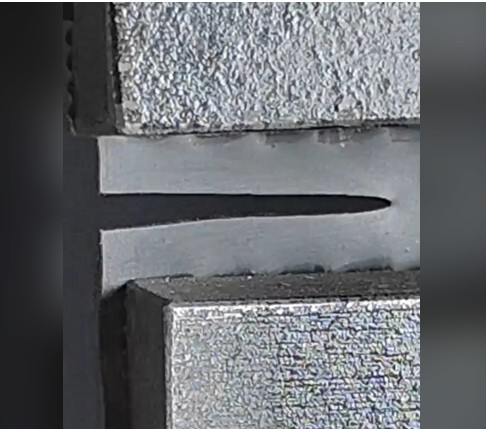
At Advanses, we perform Fatigue Crack Growth (FCG) testing to characterize Tearing Energy (T) and crack growth rate (dc/dN).
How tearing energy tests are performed
- A rubber specimen with a controlled notch is cyclically loaded.
- Crack growth rate is measured for increasing tearing energy levels.
- A material-specific curve of dc/dN vs T is established.
This curve is the fingerprint of the material’s fatigue resistance.
Why tearing energy matters for real components
Rubber components typically fail by:
- >> crack initiation at the surface or bonded interface
- >> crack growth through the thickness
- >> final tearing under multiaxial strain
Tearing energy-based fatigue analysis directly reflects this mechanism, making it far more accurate than scalar strain criteria.
4. Cracking Energy Density (CED): The Most Reliable Damage Parameter
Among all rubber fatigue parameters—strain invariants, energy release rate, max principal strain—Cracking Energy Density (CED) shows the strongest correlation with experimental crack growth data.
What is CED?
CED represents the local strain energy available on a potential crack plane. It accounts for:
- >> Normal opening energy
- >> Shear sliding energy
- >> Large strain hyperelastic behavior
- >> Multiaxial interactions
Why CED is ideal for bushings and mounts
Rubber mounts, bushings and isolators undergo:
- >> cyclic shear from engine roll
- >> compression from static load
- >> torsion from road-induced chassis motion
CED naturally combines these effects into a single physics-based metric.
During FEA fatigue simulation:
- CED is computed for each plane orientation.
- The plane with maximum damaging CED is identified.
- Material-specific crack growth curves convert CED into predicted fatigue life.
5. Full Fatigue Life Prediction Workflow at Advanses
To provide accurate durability predictions for rubber bushings, mounts, and isolators, we integrate:
Step 1: Experimental Material Testing
- >> Hyperelastic property characterization (uniaxial, biaxial, planar tests)
- >> Fatigue crack growth tests to measure dc/dN vs T
- >> Temperature-dependent fatigue behavior, if required
Step 2: FEA Simulation with Critical Plane + CED
- >> Multiaxial strain extraction across full duty cycles (road loads, engine loads)
- >> Critical plane calculation for both transient and steady-state loading
- >> CED-based damage accumulation for each location
Step 3: Life Estimation and Failure Mapping
- >> Predict life at each element surface or internal layer
- >> Identify the minimum life location
- >> Visualize fatigue contours directly inside the FEA environment
This yields a fatigue life prediction that aligns with real-world test results and field performance.

Conclusion
Predicting the fatigue life of rubber mounts, bushings, and vibration isolators is complex—but with the right physics-based tools, it becomes highly accurate and actionable.
At Advanses, we combine:
- >> Critical plane analysis to find the true crack initiation plane
- >> Experimental tearing energy testing to supply accurate material fatigue curves
- >> Cracking Energy Density (CED) as the most reliable fatigue parameter
- >> FEA-based life prediction to evaluate durability under real loading conditions
This integrated approach ensures that your rubber components meet durability, NVH, and reliability goals, reducing prototype iterations and preventing field failures.
If you need fatigue testing or FEA-based life prediction for automotive, industrial, or aerospace rubber components, Advanses can support you with end-to-end durability solutions.