Fatigue Testing of Engine, Exhaust Mounts and Vibration Isolators

OEMs and Tier 1 and tier 2 suppliers are under increased pressure to meet with 5 years and 100 thousand miles warranty on each and every rubber and plastic component in a passenger vehicle. With customer expectations for 100% reliability there is a need to fully carry out fatigue testing all the designs, at the prototyping stage . Rubber mounts and vibration isolators are used to connect a vehicle’s engine and transmission to its chassis and have to fully comply with the 5 year 100,000 miles warranty program.

They are required to reduce the transmission of vibrations, providing the desired ride characteristics and protecting the rigid frame. The elastomeric material used in these components tends to naturally degrade over a period of time due to harsh conditions in addition to material degradation. Testing the properties of these mounts under such conditions is critical to make sure that the components meet the expectations. Choosing the correct test parameters required to perform this type of automotive component tests reliably can be challenging. We have more than a decade of experience in the design, analysis and testing of these rubber elastomer mounts.

Material Properties for Finite Element Analysis (FEA)

The basic material properties that need to be known for accurate Finite Element Analysis are:

1) Stress-Strain relationship, Young’s modulus of elasticity
2) Yield strength.
3) Bulk and shear modulus.
4) Poisson’s ratio.
5) Density.

The relationship between applied mechanical force/stress and resulting deformation/strain on a given material is called its stress-strain curve or a constituent relationship equation. Isotropic materials like plastics, metals and elastomers exhibit the same behavior in all their orientations and layouts, while orthotropic and anisotropic materials, such as composites, glass-filled plastics, etc. show mechanical stress-strain properties that vary depending on the directions. Stress-strain equations and behaviors vary greatly by material type, as metals, plastics, elastomers, glass, composites, etc.

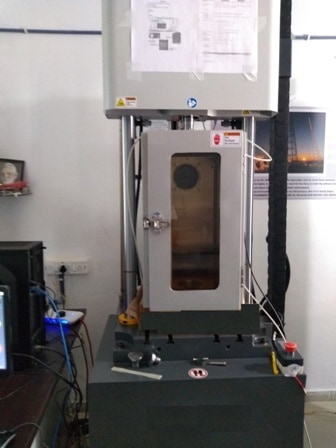
AdvanSES is a premier material testing laboratory for mechanical properties testing and component testing. We can test aged and unaged samples. Materials can be tested under static, dynamic and under elevated temperature conditions. In addition to testing and FEA, we have in-house machining facilities to develop test fixtures required to evaluate products and components for stiffness, stress, strain etc.