


At AdvanSES, we test polymer materials, rubber, plastics and composites. We also simulate it.
Over the past year, we’ve been building an in-house nonlinear FEA solver from the ground up in Python specifically tuned for hyperelastic and viscoelastic materials using AI. It’s in internal testing right now, and the architecture has grown into something worth sharing.
Here’s what the solver does under the hood:
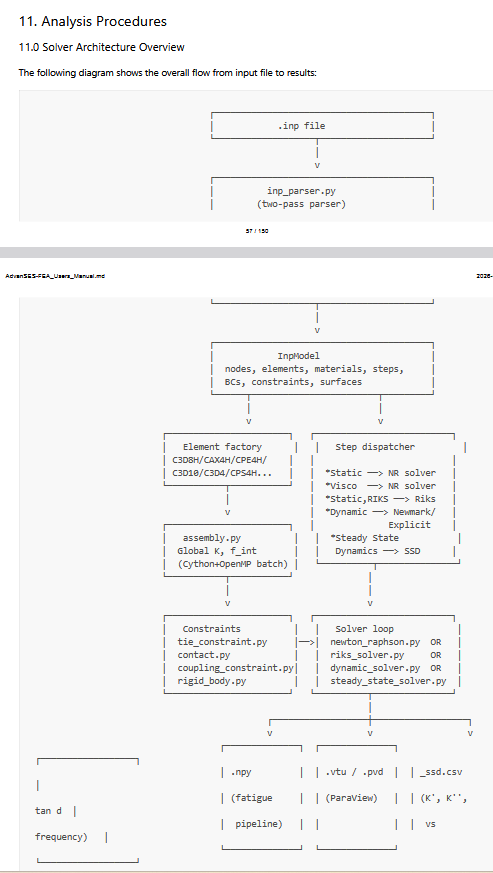
>> Parsing & Model Assembly
A two-pass .inp parser builds a full Inp Model of nodes, elements, materials, BCs, constraints, and surfaces, before anything is solved. Element support spans C3D8H, CAX4H, CPE4H, C3D10, C3D4, and CPS4H families. Global stiffness K and internal force f_int are assembled in Cython-accelerated, OpenMP-parallelized batches.
>> Step Dispatcher
The solver routes each analysis step to the appropriate kernel:
→ Static / Visco -> Newton-Raphson
→ Snap-through / instability -> Riks arc-length
→ Transient dynamics -> Newmark / Explicit
→ Frequency domain -> Steady-State Dynamics (SSD)
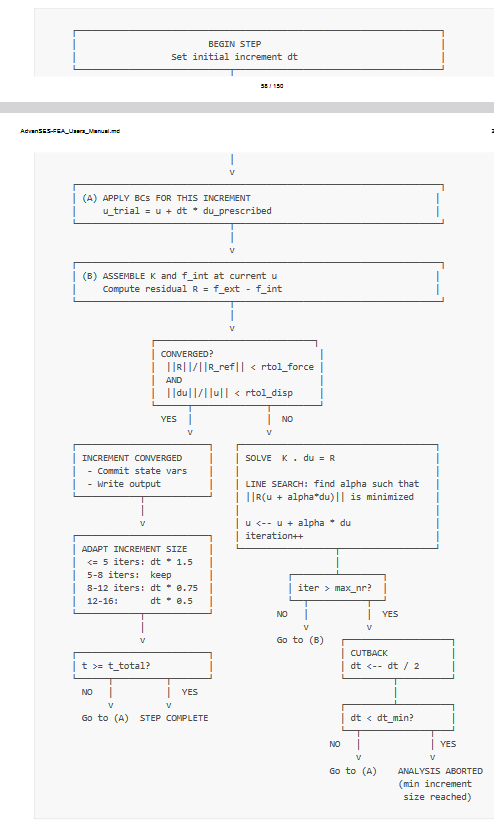
>> Newton-Raphson Loop with proper controls
This is where most solvers either earn or lose credibility. Ours implements:
- >> Dual convergence check: force residual ||R||/||R_ref|| AND displacement correction ||du||/||u|| both must satisfy their tolerances
- >> Line search: finds optimal step size α minimising ||R(u + α·du)||
- >> Adaptive increment control: dt scales up (×1.5) for fast convergence, scales down (×0.75 or ×0.5) when iterations climb, and cuts back (dt/2) on non-convergence, with a hard floor dt_min before aborting
>> Outputs
Results write to .npy arrays, .vtu/.pvd for ParaView visualisation, and ssd.csv for storage modulus K’, loss modulus K”, and tan δ vs frequency which are directly usable for bushing and mount characterization reports.
A fatigue post-processing pipeline sits downstream.
Why build this instead of using a commercial solver?
Because our clients like automotive OEMs, Tier-1 suppliers, aerospace, need traceability, customization, and results that connect directly to our physical test data and short runs on components can be carried out extremely fast in a work group without waiting for a commercial solver license to be free. A solver we understand completely is a solver we can validate completely.
We’re not replacing Abaqus. We’re building the capability to run targeted, physics-correct simulations for rubber-metal bonded components like torque rod bushings, engine mounts, isolators where our test data and simulation live in the same pipeline.
If you work on NVH characterization, durability simulation, or rubber component qualification and want to talk about what tighter test-simulation integration looks like in practice I’d be glad to connect.
