ASTM D5992 Dynamic Properties of Rubber Vibration Products

ASTM D 5992 Test Standard applies to Dynamic Properties of Rubber Vibration Products such as springs, dampers, and flexible load-carrying devices, flexible power transmission couplings, vibration isolation components and mechanical rubber goods. The standard applies to to the measurement of stiffness, damping, and measurement of dynamic modulus.

Dynamic testing is performed on a variety of rubber parts and components like engine mounts, hoses, conveyor belts, vibration isolators, laminated and non-laminated bearing pads, silent bushes etc.   to determine their response to dynamic loads and cyclic loading.

Personalized consultation from AdvanSES engineers can streamline testing and provide the necessary tools and techniques to accurately evaluate material performance under field service conditions.

The quantities of interest for measurements are tan delta, loss modulus, storage modulus, phase etc.  All of these properties are viscoleastic properties and require instruments, techniques and measurement practices of the highest quality.
Dynamic Characterization Testing as Per ASTM D5992 and ISO 4664

ASTM D5992 and ISO 4664-1

ASTM D5992 covers the methods and process available for determining the dynamic prop- erties of vulcanized natural rubber and synthetic rubber compounds and components. The standard covers the sample shape and size requirements, the test methods, and the pro- cedures to generate the test results data and carry out further subsequent analysis. The methods described are primarily useful over the range of temperatures from cryogenic to 200◦C and for frequencies from 0.01 to 100 Hz, as not all instruments and methods will accommodate the entire ranges possible for material behavior.

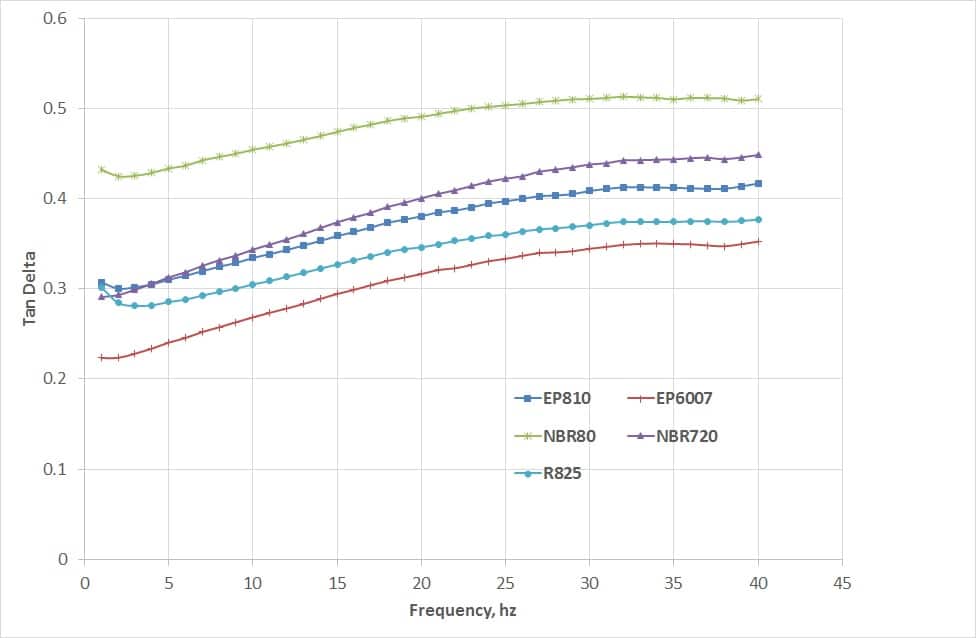
Figures(.43and.44) show the results from a frequency sweep test on five (5) different elastomer compounds. Results of Storage modulus and Tan delta are plotted.


Figure .43: Plot of Storage Modulus Vs Frequency from a Frequency Sweep Test


The frequency sweep tests have  been carried out by applying a pre-compression of  10 % and subsequently a displacement amplitude of 1 % has been applied in the positive and negative directions. Apart from tests on cylindrical and square block samples ASTM D5992 recommends the dual lap shear test specimen in rectangular, square and cylindri- cal shape specimens. Figure (.45) shows the double lap shear shapes recommended in the standard.

Figure .44: Plot of Tan delta Vs Frequency from a Frequency Sweep Test


Figure .45: Double Lap Shear Shapes