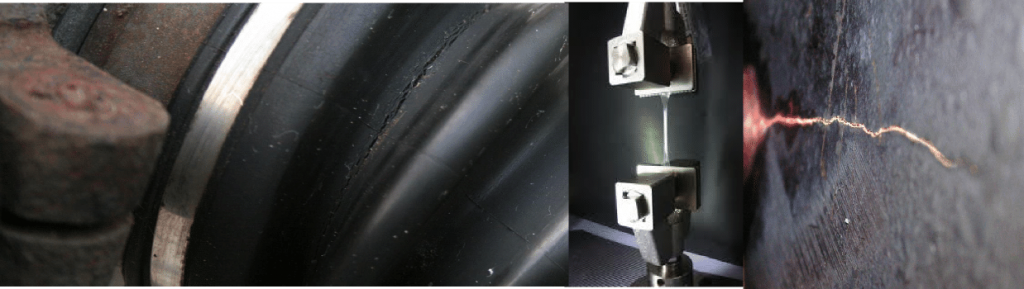
Mechanical Testing of 3D Printed Parts and Materials

A New Approach to Product Development & Rapid Prototyping

The procedure of manufacturing objects by depositing successive layers upon layers of material, based on 3D digital CAD models, is called Additive Manufacturing (AM) or simply 3D-printing. Fused Deposition Modeling (FDM) technology is one of the most widely used technique in additive manufacturing. A range of other manufacturing materials can be used for 3D printing that include nylon, glass-filled polyamide, epoxy resins, wax, and photopolymers. FDM-based polymer product manufacturing has increased in recent times due to the flexibility it offers in the production of polymer and fibre-based composite parts. FDM-based polymers have the potential to be used in all applications, currently they are primarily used in automotive, aerospace and biomedical applications.

Additive Manufacturing involves a series of processes, from ideation and design development to final product manufacturing using a specialized printer. The different steps depend on the type of manufacturing method and the material type. The primary processes and steps involved are however mostly common and remain the same for different types of manufacturing applications. The steps involved in an AM process are as shown below;

3D Printing Process

Fused Deposition Modeling (FDM)

FDM is the method of choice for manufacturing of 3d printed polymer parts and components due to its simple process, low economic cost and predictable material properties. FDM is already used in the material extrusion manufacturing process for various thermoplastic polymers. Some common thermoplastic filaments used in FDM are acrylonitrile butadiene styrene (ABS), polypropylene (PP), polylactide (PLA), polyamides (PA) like Nylon, polyether-ether-ketone (PEEK) etc. The FDM process consists of the polymer being extruded and deposited in a successive layer by layer method. FDM manufactured polymer parts and components exhibit good mechanical properties, surface finish, and manufacturability. The matrix material used in the FDM process is in the form of a 1.75mm to 2.85 mm filament wound on a spool. The filament is fed into the printer head where it is heated and melted above its glass transition temperature (Tg). The plastic melt is then passed to the nozzle and deposited layer by layer.

FDM of Fibre-Reinforced Polymers


The strength of polymeric materials can be significantly improved through reinforcement by fibres. Fibre-reinforced polymers manufactured using 3d printing technique is gaining traction. Fibre-matrix interaction and porosity are important considerations to be addressed in 3d printing of polymeric composites. FDM is currently the most preferred method for the production of polymeric fiber composites due to its material flexibility, and consistent properties.

Although the 3d printing additive manufacturing method is a sophisticated process for producing materials, and readily usable components and parts, the field service material behaviour of these printed parts is highly complicated. These properties are influenced by several process parameters such as filament material, temperature, printing speed. The material behaviour is highly anisotropic and is governed by the microstructure produced while depositing the layers and the ambient environment. The resulting material behaviour can be described using stress–strain relationships and is critical in the Finite element analysis and stress analysis of models. AdvanSES has full capability to test these complex materials and their behaviours using an array ot techniques. Mechanical testing of 3D printed parts and materials is now a key part of our portfolio of services

Mechanical Testing of 3D Printed Parts and Materials generally involves the following tests:

  1. Uniaxial tension tests
  2. Flexure tests
  3. Compression tests
  4. Poisson’s ration tests
  5. Axial Fatigue tests.

Rubber Plastic Testing Laboratory

The properties of plastics and rubber products are closely related to their composition, fillers used, processing aids additives, processing methods, etc. In order to fully understand the performance of the plastics and rubber products, it is necessary to conduct wide ranging tests on these plastics and rubber products. At AdvanSES, we are a plastic rubber testing laboratory and fully equipped to utilize these test methods and provide a full 360 degree of your material and product performance.

As a trusted laboratory partner, we offer you advanced plastic and rubber testing solutions along with the expertise of our qualified engineers. The static, dynamic and fatigue testing conducted at our laboratory ensures safe, reliable and efficient use of your polymeric materials and products in demanding end applications.

What Sets Us Apart from Other?

  • State-of-the-Art Laboratory
  • Customized and Detailed Reports
  • Turn Around Time in Hours
  • Qualified Engineers
  • Full Range of NABL Testing Scope
  • Our Problem-Solving Capabilities
AdvanSES Plastic Rubber Testing Laboratory

Static and Dynamic Testing of Engineering Materials and Products

Testing of materials and products involves mechanical loading of a material specimen or product up to a pre-determined deformation level or up to the point where the sample fails. The material properties backed out from these tests are further used to characterize the materials and products. Testing is carried out under essentially two conditions viz; Static and Dynamic.

 Physical testing of materials as per ASTM D412, ASTM D638, ASTM D624 etc., can be categorized as slow speed tests or static tests. The difference between a static test and dynamic test is not only simply based on the speed of the test but also on other test variables and parameters employed like forcing functions, displacement amplitudes, and strain cycles. The difference is also in the nature of the information we back out from the tests. Static mechanical testing is carried out at lower frequencies, generally less than one Hertz. The associated loads and applied deformation amplitudes are also smaller and the strain rate is much lower as compared to typical engineering applications. Dynamic loading is generally carried out under forcing functions and with high deformation amplitudes. These forcing functions and amplitudes are applied under a very short time period. When related to polymers, composites and elastomers, the information from a conventional test is usually related to quality control aspects of the materials or products, while from dynamic tests we back out data regarding the functional performance of the materials and products. ASTM D5992, D4092 and D5279 are some of the dynamic mechanical testing standards. High speed tensile, compression, impact, fracture tests using Split Hopkinson Pressure bars (SHPB), Servo-Hydraulic testing machines and cyclic fatigue tests fall under the category of dynamic testing.

 Polymer materials are widely used in all kinds of engineering applications because of their superior performance in vibration isolation, impact resistance, rate dependency and time dependent properties. In some traditional applications they have consistently shown better performance combining with other materials like glass fibres etc., and are now replacing metals and ceramics in such applications. The investigations of polymer properties in vibration, shock, impact and other viscoelastic phenomena is now considered critical, and understanding of dynamic mechanical behaviour of polymers becomes necessary and compulsory.

Figure 1: Static and Dynamic Testing Systems at AdvanSES

The absolute values from frequency sweep, strain sweep, temperature sweep dynamic tests are meaningful, but have little utility as isolated data points. They do become valuable data points when compared to each other or some other known variables. A tan delta or damping coefficient value of 0.4 is poor for a natural rubber or EPDM based compound, but very good in FKM materials where the structure of the compound makes it venerable to lower than optimum dynamic properties. Most uncured rubbery compounds start on the viscous side, and as we cure the compound, we shift towards the elastic side.

 The importance of dynamic testing comes from the fact that performance of elastomers and elastomeric products such as engine mounts, suspension bumpers, tire materials etc., cannot be fully predicted by using only traditional methods of static testing. Polymer and elastomer tests like hardness, tensile, compression-set, low temperature brittleness, tear resistance tests, ozone resistance etc., are all essentially quality control tests and do not help us understand the performance or the durability of the material under field service conditions. An elastomer is used in all major applications as a dynamic part being able to provide vibration isolation, sealing, shock resistance, and necessary damping because of its viscoelastic nature. 

Figure 2: Viscoelastic and Dynamic Studies Correlate Molecular Structure to Manufacturing and Mechanical Properties of Engineering Components

As it stands today, the theory of dynamic properties can be applied judiciously to product development, performance characterization or failure analysis problems. The field of application has evolved over time with availability of highly sophisticated instruments. The problems need to be studied upfront for any time or frequency dependent loading conditions and boundary conditions acting on the components and the theory be suitably applied. Needless to say that dynamic properties have utmost importance when polymeric materials and components show heat generation, and fatigue related field failures. Dynamic characterization relates the molecular structure of the polymeric materials to the manufacturing processes and to the field performance of engineering products. Dynamic properties play an important part in comparing mechanical properties of different polymers for quality, performance prediction, failure analysis and new material qualification. Dynamic testing truly helps us to understand and predict these properties both at the material and component level.

Following are the testing modes that can be implemented and the results for materials and components that one may seek from dynamic testing;

Testing Modes

Test Results Data:

1) Storage or Elastic Modulus (E’) versus temperature, frequency, or % strain

2) Loss or Viscous Modulus (E”) versus temperature, frequency, or % strain

3) Damping Coefficient (Tan Delta) versus temperature, frequency, or % strain

4) Stress vs Strain properties at different strain rates.

5) Strain vs Number of Cycles for a material or component under load control fatigue.

6) Load or Stress vs Number of Cycles for a material or component under strain control fatigue.

7) Fatigue crack growth vs Number of Cycles for a material under strain controlled fatigue.

 No single testing technique or methodology provides a complete picture of the material quality or component performance. It is always a combination of testing methods and techniques that have to be applied to obtain a 360 degree view of the material quality and performance.

References:

1) Ferry, Viscoelastic Properties of Polymers, Wiley, 1980.

2) Ward et al., Introduction to Mechanical Properties of Solid Polymers, Wiley, 1993.

3) TA Instruments, Class Notes and Machine Manuals, 2006.

4) Lakes, Roderick., Viscoelastic Materials, Cambridge University Press, 2009.

5) Srinivas, K., and Pannikottu, A., Material Characterization and FEA of a Novel Compression Stress Relaxation Method to Evaluate Materials for Sealing Applications, 28th Annual Dayton-Cincinnati Aerospace Science Symposium, Ohio, March 2003.

NON-LINEAR FEA & MODELING OF RUBBER & POLYMERS

Rubber and different types of polymer materials are widely used for a variety of applications, such as vibration isolation mounts, seals, o-rings and gaskets, shock mounts, and tires. The mechanical properties of these materials allow them to act as excellent dampers providing high compliance over a long fatigue life.

This course provides a brief overview of different types of rubber and polymer materials in the automotive and biomedical industries. The main focus of this short class is to teach the attendees to:

  • Introduction to Polymers and Rubber materials for Engineering Applications.
  • Non-linear Rubber Elasticity.
  • Hyperelastic Strain Energy Functions.
  • Mechanical Material Testing and Curve Fitting in FEA Softwares (Theory and Application).
  • Hands-on Workshop.
  • Questions and Answers Session.

This course is recommended for design engineers, FEA analysts, engineers working with new product development etc.

NON-LINEAR FEA & MODELING OF RUBBER & POLYMERS

Meet, Greet & Discuss at AdvanSES on 20/02/2021

Meet & Greet - Networking Event for Product Engineers and Polymer Technologists - organized by TechnoBiz and Hosted by Advanses 


3:00 PM - Welcome Remarks by Kartik Srinivas, AdvanSES 

Message from Peram Prasad Rao, TechnoBiz

Advanses presentation

Participants introduction

Visit the facility 

Coffee break

Round table seating - technical problems and discussionTypography is the art and technique

5:00 PM - Closing Remarks

RSVP Form Below

https://forms.gle/DUdocLBPsCYHAS5H9 


Fatigue testing at AdvanSES. AdvanSES’ laboratory provides testing solutions to fully characterize your parts and components

The endurance and durability testing of rubber polymer components is a functional fatigue test that helps to characterize and understand the in-service life performance of parts and components. Testing is Cyclic in nature and carried out as either in stress control testing (load mean level, load, stress amplitude)or under strain controlled testing (mean strain level, displacement, amplitude).

Using servo-hydraulic fatigue testing systems and digital test controllers capable of ultra-fast PID control, different controling modes are normally achieved. Typical criteria are:

1) Number of cycles at a specified strain or stress level
2) Amplitude or Position under specific load
3) Elastomeric parameters like stiffness, damping, etc., falling outside specified range

Parts and Component Testing at AdvanSES, Room and at Elevated Temperatures

Fatigue testing of the following elastomeric parameters can be studied over the components life under the endurance or durability test;

1) Storage or Elastic Modulus (E’)
2) Loss or Viscous Modulus (E’’)
3) Phase or Loss Angle Delta (Degrees or radians)
4) Damping Coefficient (Tan Delta)

5) Complex or Dynamic Modulus (E)

6) Energy Loss

7) Dynamic Stiffness (K)
8) Frequency Sweep

These calculations and results of these properties helps component designers to comeup with designs and material compounds that provide enhanced service life and durability.

Our laboratory has the capabilities to provide the following test requirements;

1) High cycle and Low Cycle Fatigue testing
2) Fatigue crack growth rate measurements
3) Fracture toughness testing
4) Tensile testing
5) Slow strain rate testing
6) Advanced material characterisation

Contact us for a quick quote on your testing needs.

Advanced Scientific and Engineering Services (AdvanSES) Laboratory Earns Renowned ISO/IEC 17025:2017 Accreditation

AdvanSES announces that its Testing Laboratory has attained ISO/IEC 17025:2017 accreditation vide NABL certificate No. TC-9168. ISO/IEC 17025:2017 is the highest recognized quality standard in the world for calibration and testing laboratories. Accreditation means the lab consistently produces precise and accurate test data and has implemented a rigorous quality management system. The stringent processes in the audits for the accreditation relate to the operations, efficiency and effectiveness of the laboratory. Test data from the laboratory is benchmarked for accuracy, reliability and consistency.

Receiving the accreditation means that test reports and certificates generated from AdvanSES laboratory can now be generally accepted from one country to another without further testing. 

The scope of the accreditation covers tests and properties in the field of rubbers, plastics and composite materials. It is one of the few labs in the world accredited to perform internationally recognized fatigue standards like ASTM D7791.

AdvanSES today is one of the few companies in the world who provide expert problem solving services using Finite element analysis (FEA), provides new product development and material testing and analysis.

National Accreditation Board for Testing & Calibration Laboratories (NABL) provides accreditation to Conformity Assessment Bodies (Laboratories). NABL Schemes include Accreditation (Recognition) of Technical competence of testing, calibration, medical testing laboratories, Proficiency testing providers (PTP) & Reference Material Producers (RMP) for a specific scope following ISO/IEC 17025ISO 15189ISO/IEC 17043 & ISO 17034:2016[3] Standards. It has Mutual Recognition Arrangement (MRA) with Asia Pacific Laboratory Accreditation Cooperation (APLAC), International Laboratory Accreditation Cooperation (ILAC).

NABL is a constituent board of Quality Council of India which is an autonomous body setup under Department for Promotion of Industry and Internal Trade (DPIIT)Ministry of Commerce and IndustryGovernment of India

Rubber and Plastic Materials Testing Laboratory

The sole purpose of an engineering laboratory is to provide engineering product development and problem solving services to industries by carrying out controlled condition experiments and engineering analysis. These controlled condition experiments are done using testing machines, computational mechanics tools and advanced engineering softwares. At AdvanSES we use state of the art testing equipments to conduct material testing on any kind of metals, polymers and composite materials. Our computational mechanics tools like Abaqus Finite element analysis software, our in-house machine shop aid us in this process.

Material Testing:


Testing methodologies are primarily divided into two (2) categories depending upon the test rate; static and dynamic. AdvanSES has both static and dynamic testing capabilities. We are able to provide a full 360 degree view of any material or product’s mechanical characteristics. We can also strength, strain, fatigue, hardness, and lots more.

Our testing methods include the following:

1. ASTM D638 – Standard Test Method for Tensile Properties of Plastic

2. ASTM D882 – Standard Test Method for Tensile Properties of Thin Plastic Sheeting

3. ASTM D412 – Standard Test Methods for Vulcanized Rubber and Thermoplastic Elastomers in Tension

4. ASTM 5992 – Standard for Dynamic Testing of Vulcanized Rubber and Rubber-Like Materials Using Vibratory Methods. Tan delta, storage modulus, loss modulus testing.

5. ASTM D430 – Standard Test Methods for Rubber Deterioration—Dynamic Fatigue

6. ASTM D573 – Standard Test Method for Rubber—Deterioration in an Air Oven

7. ASTM D624 – Standard Test Method for Tear Strength of Conventional Vulcanized Rubber and Thermoplastic Elastomers

8. ISO 6943 – Determination of Tension Fatigue of Rubber and Polymer materials

9. ASTM D395 – Standard Test Methods for Rubber Property—Compression Set

10. ASTM D6147, ISO 3384 – Standard Test Methods for polymer and Rubber Property—Compression Stress Relaxation

11. ASTM D575 – Standard Test Methods for Rubber Properties in Compression

12. ASTM D2990 – Standard Test Methods for Tensile, Compressive, and Flexural Creep and Creep-rupture of Plastics

13. ASTM D1709 – Standard Test Method for Drop Impact Test

14. ASTM D7264 – Flexural Properties of Composites

15. ASTM D3410 – Compression of Composites

16. Hyperelastic Material Characterization for CAE. Mooney-Rivlin, Ogden, Yeoh etc. Constants.

17. Plastic Material Characterization for CAE

18. ASTM E399 and ASTM E1820 – Fracture Toughness Testing

19. High Cycle Fatigue HCF Testing

20. Low Cycle Fatigue LCF Testing

21. ASTM E647 –  Measurement of Fatigue Crack Growth Rates (da/dN)

22. IS 4664 – Standard for Dynamic Testing of Vulcanized Rubber and Rubber-Like Materials Using Vibratory Methods. Tan delta, storage modulus, loss modulus testing.

23. IS 3400 – Standard Test Methods for Vulcanized Rubber and Thermoplastic Elastomers in Tension

24. ASTM D790 and D6272 – 3-Point and 4-point Bend Flexure tests for unreinforced and reinforced thermoplastic and composite materials.

AdvanSES Rubber, Plastic, Composite Materials Testing Laboratory

What is the importance of materials testing?

Materials testing helps us to quantify, and understand whether a material or product is suitable to a certain application. Materials testing points us to limits of a material to handle a load or an operating condition. Materials that have not been tested and directly used in a product can be extremely dangerous. The data collected during testing and the final test results can be very useful to engineers, designers, manufacturing engineers and even the marketing department.

Mechanical properties could be determined for all types of materials that are found in aerospace, automotive and biomedical applications. The following mechanical tests could provide more information on the mechanical properties and characteristics of materials,
• Ductility and Hardness
• Stress and Strain
• Elongation at break
• Impact Resistance
• Fracture Toughness
Fatigue under controlled stress or strain
• Creep

Following are some of the reasons material testing is important:

  • Meeting requirements of regulatory agencies
  • Evaluating product designs, analyzing a field failure or optimizing a product
  • Selecting appropriate materials for end use applications
  • Verifying a production method or conditions

Apart from following a process or procedure to test a mateiral or a product, manufacturers can also make sure that their products conforms to some international test standards like IS, BIS, ISO, ASTM, DIN etc. This is one of the best ways to make sure that the material and product is worth in terms of quality. Regulatory agencies also require that products be tested as per standards before providing the go-ahead to market launch.

Material and product testing setup at AdvanSES